Kirsten primarily works within the Arts industry, photographing actors, Theatre and music.
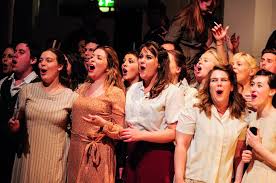
Theatre production images. I reviewed some of the theatre work as I have recently completed a set of images of a theatre production, I was interested to see the professional approach. Many of the images were taken with wide lens making the viewer feel part of the scene. I noticed the same challenges I'd faced with the variety of studio lighting, sometimes bright, sometimes coloured and often with a mixture of the two. Many images had things in them that I would have spent a great deal of time trying to Photoshop out of the frame, for example, the green fire exit light that always seems to be in the wrong place, in many of these images it was at the edge of someones face or hat, I would have probably binned my images with the same issue. Also, some of the images had blurring, limbs missing or had feet chopped off, which again I would have binned. What was overwhelming with these images though was the sense of the images being 'real', that this was exactly how it happened, regardless of the fire exit light, the story, the message was, it seemed, more important than perfection of the image, which on the whole inspired me a great deal, I try to take the perfect image, spend hours pouring over them to see if I can make them better but perhaps I'm missing the point? Maybe with theatre photography, there is a story to tell, but there is also the passion of the way it is delivered, and this is maybe best portrayed by showing the production as it was, that by showing the actors 'in the moment' you are portraying exactly that. Kirsten's approach to continuity creates a set of images that almost make you feel as though you have actually seen the performance, a large number of images that lead on from each other with what seems like little time between with facial and physical expression adding to the telling of the story and performance.
(permission to add images obtained from Kirsten McTernan)
 |
| ©Kirstan McTernan |
 |
| ©Kirstan McTernan |
Portfolio favorites. The first thing I noticed with theses sets of images were that a lot of them had a square format. The choice of background, fashion, furniture and colours can really add something special, dating the images, which was obviously the intention but was very effective.
 |
| ©Kirstan McTernan |
Some of the portraits included items in the background I would have initially cropped or moved ie prop or a chair not seeming to serve a purpose and also facing the wrong way, but leaving it in seemed to give the images depth interest, when I imagined the images without the items, some were quite different and there is more to look at for the viewer and others might have benefited from a crop, demonstrating the moment as it happen.
 |
| ©Kirstan McTernan |
This image demonstrates the variety of the angle of the images, and the importance of moving around the subject taking images from all angles:

